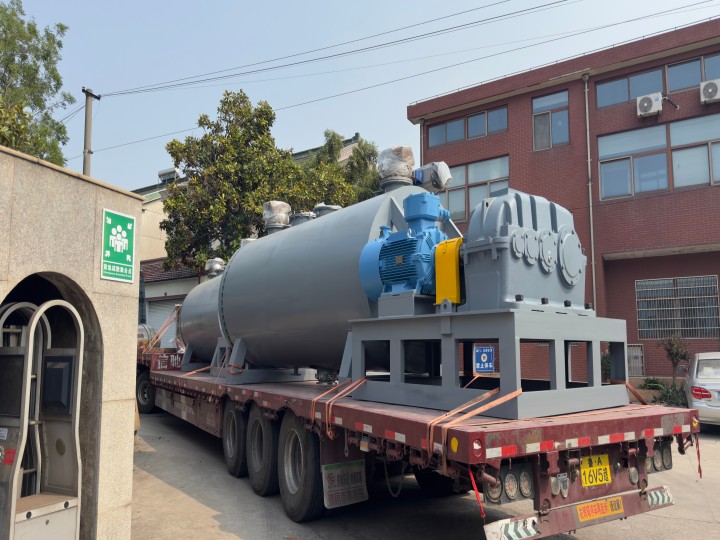



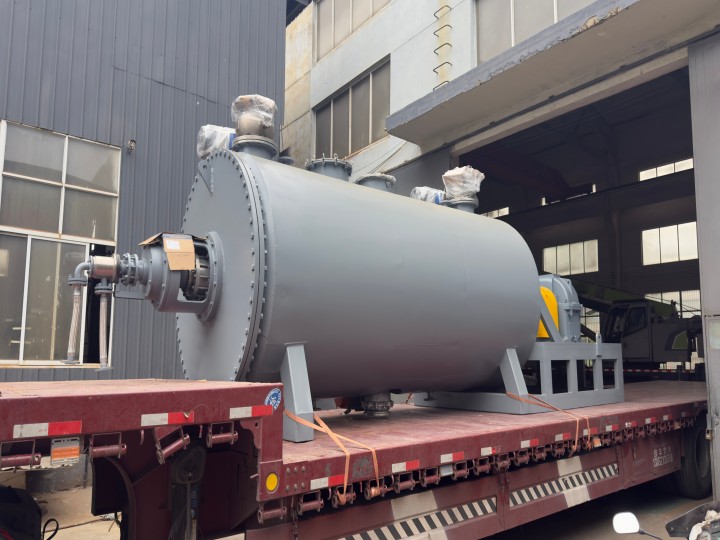
The ZPG-8000L vacuum rake dryer has been shipped.
Views: 0 PublishTime: 2026-09-01
Introduction of vacuum rake dryer:
Vacuum rake dryer is a horizontal indirect heat transfer, intermittent vacuum drying equipment. The core principle is to use a jacket/hollow shaft to introduce a thermal medium (such as steam, heat transfer oil, hot water) to indirectly heat the material, and at the same time use the built-in rake teeth to flip the material under a negative pressure vacuum state, so that the moisture or solvent can be evaporated at a low evaporation temperature. Quickly evaporate at temperature and extracted by the vacuum system.
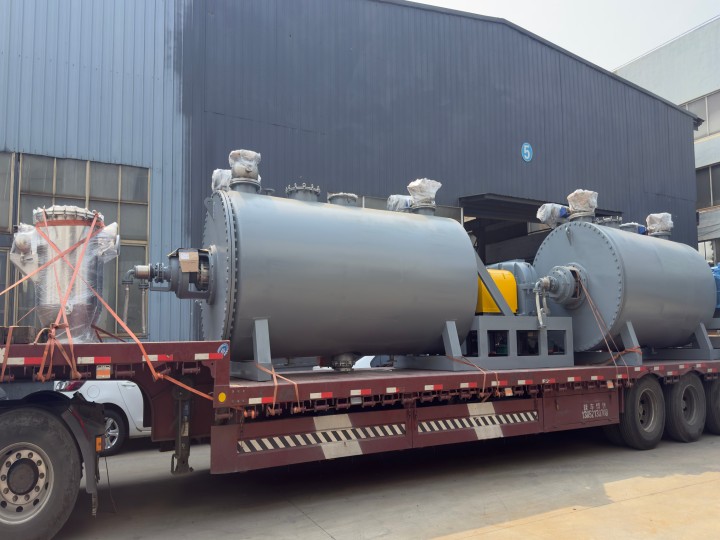
1. Core structure and working principle:
Sealed shell and jacket: Horizontal cylinder structure, equipped with heating jacket on the outside (semi-tube or hollow blade inside can also be used), and the inside is subjected to negative pressure vacuum.
Harrow teeth and mixing shaft:
Positive and negative rotation transmission: The mixing shaft drives the harrow teeth to rotate alternately positive and negative. When rotating forward, the material is pushed to both sides, and when rotating backward, the material is collected in the middle to ensure uniform heating of the material and prevent coking on the wall.
Special-shaped rake tooth design: combines "pushing" and "crushing" functions, and some models are equipped with internal crushing rods (knocking rods) that can crush the lumps formed during the drying process.
Condensation and vacuum system: The vaporized solvent passes through the filter/dust remover and enters the condenser for recovery, and the non-condensable gas is pumped away by the vacuum pump.
2. Core technology advantages and limitations
advantages
1. Low temperature and high efficiency: The boiling point of the solvent is reduced under vacuum, suitable for heat-sensitive materials
2. High solvent recovery rate: Fully enclosed system, combined with condenser, solvent recovery rate can reach more than 90%
3. Suitable for high-viscosity/pasty materials: Strong stirring to prevent the material from sticking to the wall and local overheating
4. Intrinsic safety: Low oxygen and negative pressure environment, suitable for flammable, explosive and highly toxic materials
limitations
1. Intermittent production: feeding, drying, and discharging are carried out in batches, with poor continuity
2. Mechanical wear: There is shear wear on particulate materials, which is not suitable for maintaining the crystalline crystal form
3. Complex structure: vacuum shaft seals (mechanical seals) need regular maintenance to prevent leaks
4. Cleaning is relatively cumbersome: there are many internal mechanical parts, and the cost of cleaning dead corners when switching between multiple varieties is high
3. Key selection and design parameters:
When selecting engineering and equipment, we need to focus on the following core parameters:
Heat transfer area and filling rate:
Charging factor (filling rate): generally controlled at 30% ~ 50%. If the filling ratio is too high, it will affect the evaporation space and stirring efficiency, and if it is too low, the heat transfer efficiency will decrease.
Heating medium selection:
Hot water/hot water cycle: below 80°C, suitable for extremely heat-sensitive materials.
Saturated steam: 0.2 - 0.6 MPa (120°C - 160°C), the most common high-efficiency medium.
Heat transfer oil: 150°C - 250°C, suitable for high boiling point solvent removal.
Shaft seal form (key to leakage prevention):
Packing sealing: Low cost, but easy to leak, only suitable for general materials.
Double-faced mechanical seal (with gas/liquid flushing): Standard for materials with high vacuum, highly toxic or containing strong corrosive solvents.
Discharge valve selection:
Vacuum pneumatic ball valve/pneumatic plunger valve is used, and the discharge port must be designed to be flush with the inner wall of the cylinder (i.e.,"no-dead-angle valve") to prevent accumulated material from drying.
4. Common faults and maintenance points:
Vacuum drops:
Reason: Wear of mechanical seals, aging of discharge valve/manhole cover sealing rings, poor cooling effect of condenser, resulting in insufficient condensation of vaporized solvent.
Main shaft abnormal sound or stuck:
Reason: During the drying process of the material, the resistance to entering the "binding phase (mastic)" suddenly increases, or the rake teeth collide with the inner wall; the reducer and transmission chain need to be checked.
Dust enters the vacuum pump:
Reason: The built-in bag filter (or titanium filter element) on the upper part of the cylinder is damaged or the blowback system fails.