



Copper sulfate special dryer
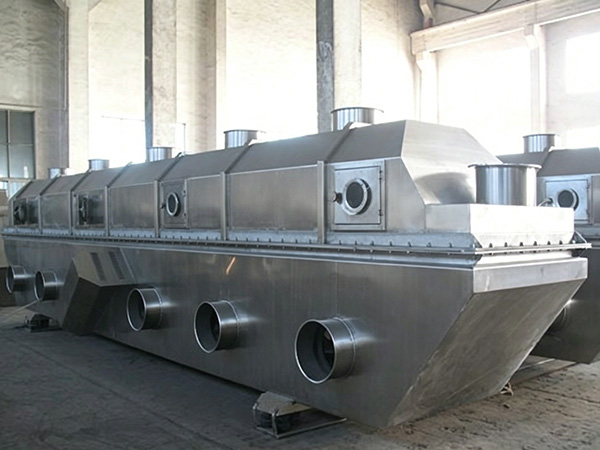
Brief description of copper sulfate materials:
Copper sulfate is a white or gray-white powder. Its aqueous solution is weakly acidic and appears blue. Copper sulfate is an important raw material for the preparation of other copper-containing compounds. Mixed with milk of lime to give Bordeaux mixture, which is used as a fungicide. At the same time, copper sulfate is also the electrolyte used when electrolytic refining copper.
Product introduction of copper sulfate special dryer:
In the fluidized bed dryer, the material enters the machine from the feed inlet. Under the action of vibration force, the material is thrown along the horizontal fluidized bed and moves forward continuously. After the hot air passes upwards through the fluidized bed and exchanges heat with the wet material, the wet air passes through the cyclone separator. After dust removal, it is discharged by exhaust air at a ratio of 1:3. Dry materials are discharged from the discharge inlet. It is suitable for drying and cooling of powdery and granular materials in chemical, pharmaceutical, food, dehydrated vegetable, grain, mineral and other industries.
Usage conditions of special copper sulfate dryer:
1. For the materials to be dried, there are certain restrictions on the granularity, and it is generally more suitable to be greater than 30um and less than 6 mm. If the particle size is too small, it will easily be entrained by the airflow, and if the particle size is too large, it is not suitable for vulcanization.
2. If several materials are mixed together for fluidized bed drying, the relative densities of several materials are required to be close. Otherwise, particles with low relative density will be more easily entrained by the airflow than particles with high relative density, which will also affect their dryness.
3. Materials with too high water content and easy to stick into clusters are generally not suitable.
4. Materials that are easy to build walls and agglomerate are prone to equipment wall building and bed blocking during vulcanization and drying.
5. The longitudinal back-mixing of materials in the bed of fluidized bed drying equipment is fierce. For unipolar continuous drying, due to the uneven residence time of the material in the equipment, the product will be discharged unevenly dry and wet.
6. Materials that require beautiful appearance should not be used. For valuable and toxic materials, careful consideration should be given to complete recycling devices.
Advantages of a special copper sulfate dryer:
1. In the fluidized bed drying equipment, the fluid and solid particles are fully mixed, and there are many opportunities for surface renewal, which greatly enhances the heat and mass transfer between the two phases, so the temperature in the bed is relatively uniform. At the same time, it has a very high heat capacity coefficient (or volume heat transfer coefficient), which can generally reach 8000-25000KJ/(m?·h·℃)。The production capacity is large, and it can dry hundreds of tons of materials per hour.
2. Compared with the old box drying equipment or rotary drum drying equipment, fluidized bed drying equipment has the advantages of short material retention time and high drying rate; it is also suitable for drying some heat-sensitive materials.
3. The equipment is simple, easy to manufacture, convenient to maintain, and easy to amplify the equipment.
4. The residence time of the material in the fluidized bed drying equipment can be adjusted according to the process production requirements. When product moisture content requirements change or raw material moisture content fluctuates, appropriate adjustments can be made.
5. In the same equipment, operations can be generated continuously or intermittently.